
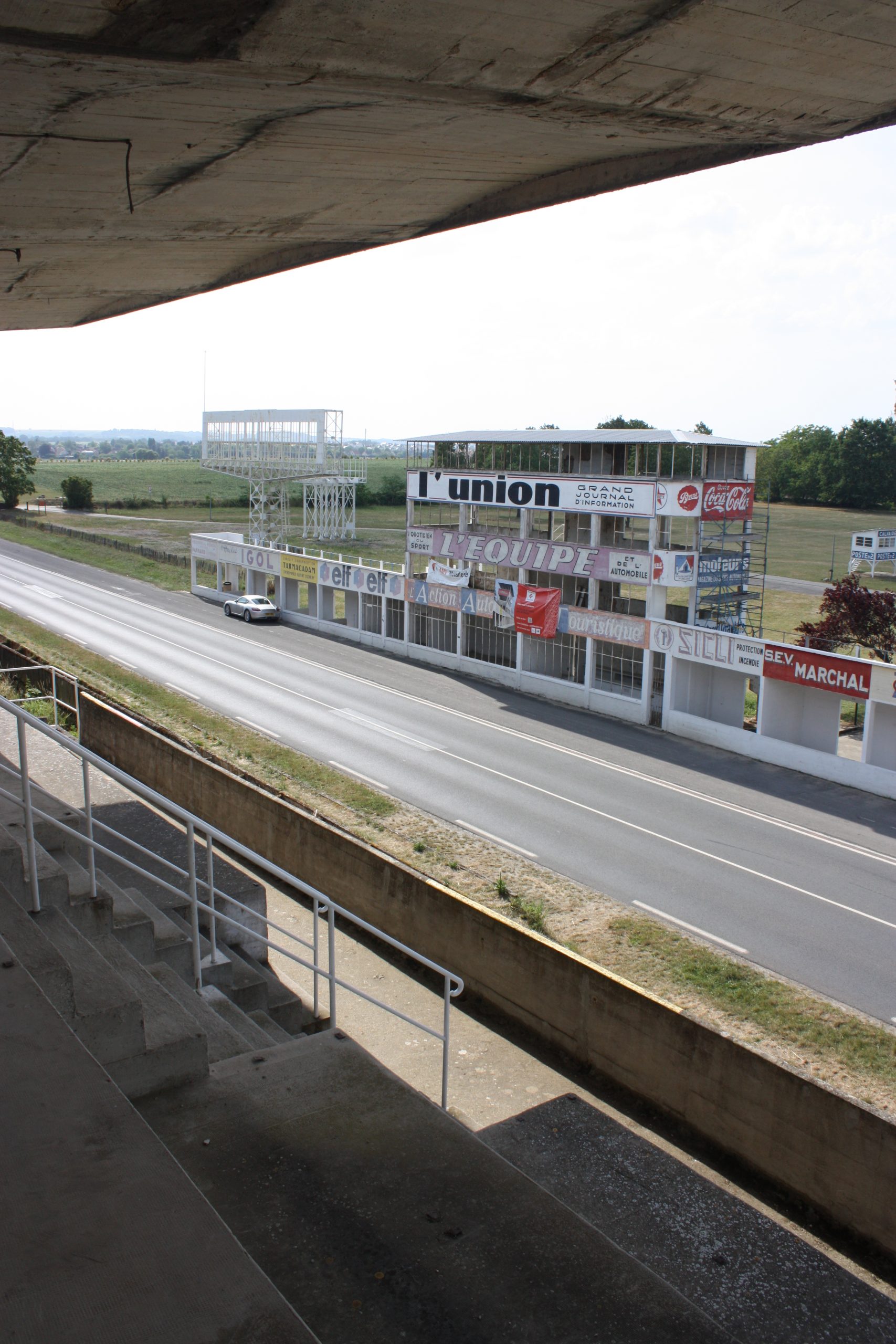
There are some historic motorsport venues where very little remains beyond a plaque, a line of trees or a modern road following the old circuit. Reims-Gueux is completely different…
Located just outside Reims in France’s Champagne region, the remains of the circuit architecture still sit beside a public road. The old pit buildings, race-control tower, grandstands and painted advertising signs create one of the most evocative motorsport locations I have ever visited.
I travelled to Reims-Gueux to explore the circuit and film a video for the Autobunker YouTube channel. Although I had seen plenty of photographs beforehand, they did not fully prepare me for how atmospheric the place would feel, even in the middle of a heatwave!
Check out the video of the whole experience on the Autobunker YouTube channel here.
What is the Reims-Gueux circuit?
Reims-Gueux was a high-speed road-racing circuit built around public roads between the villages of Gueux, Thillois and Muizon, west of Reims. The original circuit was first used in 1926 and became famous for its extremely long straights, high speeds and slipstreaming battles. It hosted the French Grand Prix, Formula One and the 12 Hours of Reims before closing permanently in 1972.
Unlike a modern purpose-built circuit, Reims-Gueux was integrated into the surrounding landscape. Ordinary roads were transformed into one of Europe’s fastest race tracks, with cars charging through the countryside before heavy braking for a small number corners. That combination of motorsport history and everyday rural surroundings is what I think makes a visit so fascinating for motorsport fans.
What is it like to visit Reims-Gueux today?
The surviving buildings are concentrated along the old pit straight beside the D27, approximately seven kilometres west of central Reims. The location is easy to reach by car, and the historic structures are clearly visible as you approach.
My first impression was just how accessible everything felt – that makes it much easier to imagine the circuit in operation. Standing in the old garages, I could imagine mechanics leaning over the pit wall, drivers accelerating along the straight and spectators filling the grandstands opposite.
The restored period advertisements are particularly evocative, they help return some colour and identity to buildings that might otherwise appear abandoned. Much of this preservation has been undertaken by enthusiastic volunteer organisations working to protect the site and keep its history accessible. Find out more here.
Is Reims-Gueux a good place to film and photograph?
For anyone interested in automotive photography or video, Reims-Gueux offers an extraordinary backdrop. The pit garages, weathered concrete, control tower and long perspective down the former straight provide numerous filming angles that can make any car look good!
My challenge was to capture the scale and atmosphere of the site rather than simply recording a sequence of old buildings. Wide shots helped establish the relationship between the circuit and the surrounding countryside, while closer details revealed old signage, paintwork and architectural features.
The local traffic also brings the location to life, although it creates an obvious safety consideration. The former main straight remains a public road, so visitors need to remain well away from moving vehicles and avoid stepping into the carriageway to capture a photograph or camera angle. Visiting at a quieter time of day can make filming easier, but it is still important to respect any barriers, restrictions and areas that are not open to the public.
Is Reims-Gueux worth visiting?
To the average punter, Reims-Gueux might appear to be a collection of old concrete buildings beside a French country road. For a car enthusiast however, it is a really powerful place.
It provides a physical connection to an era when Grand Prix racing took place on fast and unforgiving public-road circuits. You can see the modest facilities, look along the former straight and appreciate how different the sport was from the controlled environment of a modern Formula One venue.
I would particularly recommend visiting Reims-Gueux as part of a road trip through northern France or the Champagne region. It does not require an entire day, but it deserves more than a hurried photograph from the roadside. Filming there gave me the opportunity to tell part of the circuit’s story, but simply spending time at Reims-Gueux was equally valuable. It is a reminder that motorsport history does not only survive inside museums. Sometimes it remains exactly where it happened, waiting beside an ordinary road.
Check out the video of my visit to the circuit on the Autobunker YouTube channel here.
Leave a Reply